

Hey there! As a supplier of Screw Augers, I often get asked about how to calculate the capacity of these nifty devices. So, I thought I'd put together this blog post to break it down for you in simple terms.
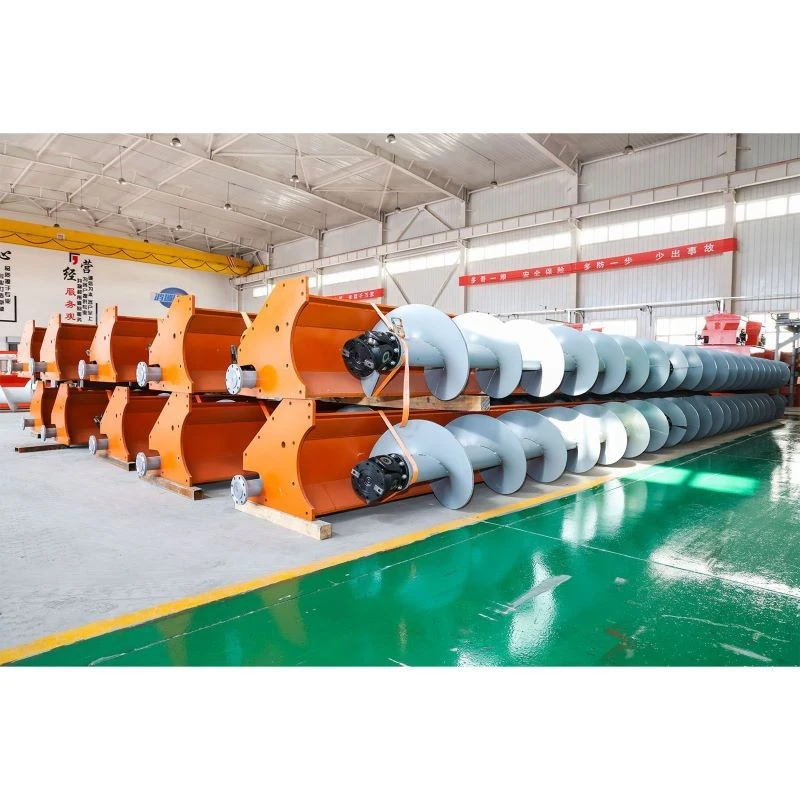
First off, let's understand what a Screw Auger is. A Screw Auger is basically a helical screw blade, also known as a flighting, that rotates inside a tube or trough. It's used to move various materials like grains, powders, and even liquids from one place to another. Now, calculating its capacity is crucial if you want to make sure it can handle the workload you have in mind.
Basic Factors Affecting Screw Auger Capacity
There are several factors that come into play when calculating the capacity of a Screw Auger. The main ones are the diameter of the auger, the pitch of the flighting, the rotational speed of the auger, and the material being conveyed.
Diameter of the Auger
The diameter of the Screw Auger is a key factor in determining its capacity. A larger diameter means more material can be carried in one revolution. Think of it like a big bucket compared to a small one – the big one can hold more stuff. So, if you need to move a large volume of material, you'll likely want a Screw Auger with a larger diameter.
Pitch of the Flighting
The pitch of the flighting refers to the distance between consecutive turns of the helix. A larger pitch means the auger will move the material along more quickly, increasing the capacity. However, it's important to find the right balance. If the pitch is too large, the material might not get properly conveyed and could spill out.
Rotational Speed
The speed at which the Screw Auger rotates also affects its capacity. The faster it spins, the more material it can move in a given amount of time. But, like with the pitch, there's a limit. If the auger spins too fast, it can cause excessive wear and tear, and it might not convey the material efficiently.
Material Characteristics
Different materials have different properties, such as density, particle size, and flowability. These characteristics can significantly impact the capacity of the Screw Auger. For example, a material that's very dense will require more force to move, and a material with poor flowability might not move smoothly through the auger.
Formula for Calculating Screw Auger Capacity
The formula for calculating the capacity of a Screw Auger is as follows:
[ C = \frac{\pi}{4} D^2 P N \eta \rho ]
Where:
- ( C ) is the capacity in cubic meters per hour (or other appropriate volume per time unit)
- ( D ) is the diameter of the auger in meters
- ( P ) is the pitch of the flighting in meters
- ( N ) is the rotational speed in revolutions per minute (RPM)
- ( \eta ) is the efficiency factor, which takes into account factors like the type of material and the design of the auger
- ( \rho ) is the density of the material in kilograms per cubic meter
Let's break this formula down a bit. The ( \frac{\pi}{4} D^2 ) part calculates the cross - sectional area of the auger. Multiplying this by the pitch ( P ) gives the volume of material that would be moved in one revolution of the auger. Then, multiplying by the rotational speed ( N ) gives the volume moved per minute. The efficiency factor ( \eta ) adjusts the calculated volume to account for real - world losses, and the density ( \rho ) is used if you want to calculate the mass capacity instead of just the volume capacity.
Example Calculation
Let's say we have a Screw Auger with a diameter ( D = 0.2 ) meters, a pitch ( P = 0.15 ) meters, a rotational speed ( N = 30 ) RPM, an efficiency factor ( \eta = 0.8 ), and we're transporting a material with a density ( \rho = 800 ) kg/m³.
First, calculate the cross - sectional area:
[ A=\frac{\pi}{4}D^{2}=\frac{\pi}{4}(0.2)^{2}\approx 0.0314\ m^{2} ]
Then, calculate the volume moved in one revolution:
[ V_{1}=A\times P = 0.0314\times0.15 = 0.00471\ m^{3} ]
The volume moved per minute is:
[ V_{m}=V_{1}\times N=0.00471\times30 = 0.1413\ m^{3}/min ]
The volume capacity per hour is:
[ C_{v}=V_{m}\times60 = 0.1413\times60 = 8.478\ m^{3}/h ]

The mass capacity is:
[ C_{m}=C_{v}\times\eta\times\rho=8.478\times0.8\times800 = 5425.92\ kg/h ]
Importance of Accurate Capacity Calculation
Accurately calculating the capacity of a Screw Auger is super important. If you underestimate the capacity, the auger won't be able to handle the amount of material you need to move, which can lead to production delays. On the other hand, if you overestimate the capacity, you'll end up spending more money on a larger and more expensive auger than you actually need.
Related Products
In addition to Screw Augers, we also offer other related products that can enhance the performance and safety of your material handling system. For example, a Dust Control Hopper can help keep the working environment clean and safe by capturing dust generated during the material handling process. And if you're working in a potentially explosive environment, our Explosion - proof Slip Ring can provide a reliable and safe way to transfer power and signals to the rotating parts of the auger. Also, we have high - quality Auger Shaft options available to ensure the durability and smooth operation of your Screw Auger.
Wrapping Up and Next Steps
So, there you have it! That's how you calculate the capacity of a Screw Auger. It might seem a bit complicated at first, but once you understand the basic factors and the formula, it's not too bad. If you're in the market for a Screw Auger or any of our related products, don't hesitate to reach out. We're here to help you find the right solution for your specific needs. Whether you need to calculate the capacity for a new project or want to upgrade your existing system, we've got the expertise to assist you.
If you have any questions or need further advice on calculating the capacity of a Screw Auger or choosing the right product for your application, feel free to contact us. We look forward to discussing your requirements and helping you make the best decision for your business.
References
- Perry, R. H., & Green, D. W. (1997). Perry's Chemical Engineers' Handbook. McGraw - Hill.


